Rebuild of a fictional joinery workshop’s site
Concept project
The site we built with deliberate faults for our sample audit, rebuilt as 5 plain HTML pages that address all 15 findings. On Lighthouse’s slow-phone test its home page now shows its main content in 0.8 s, not 45.5 s.
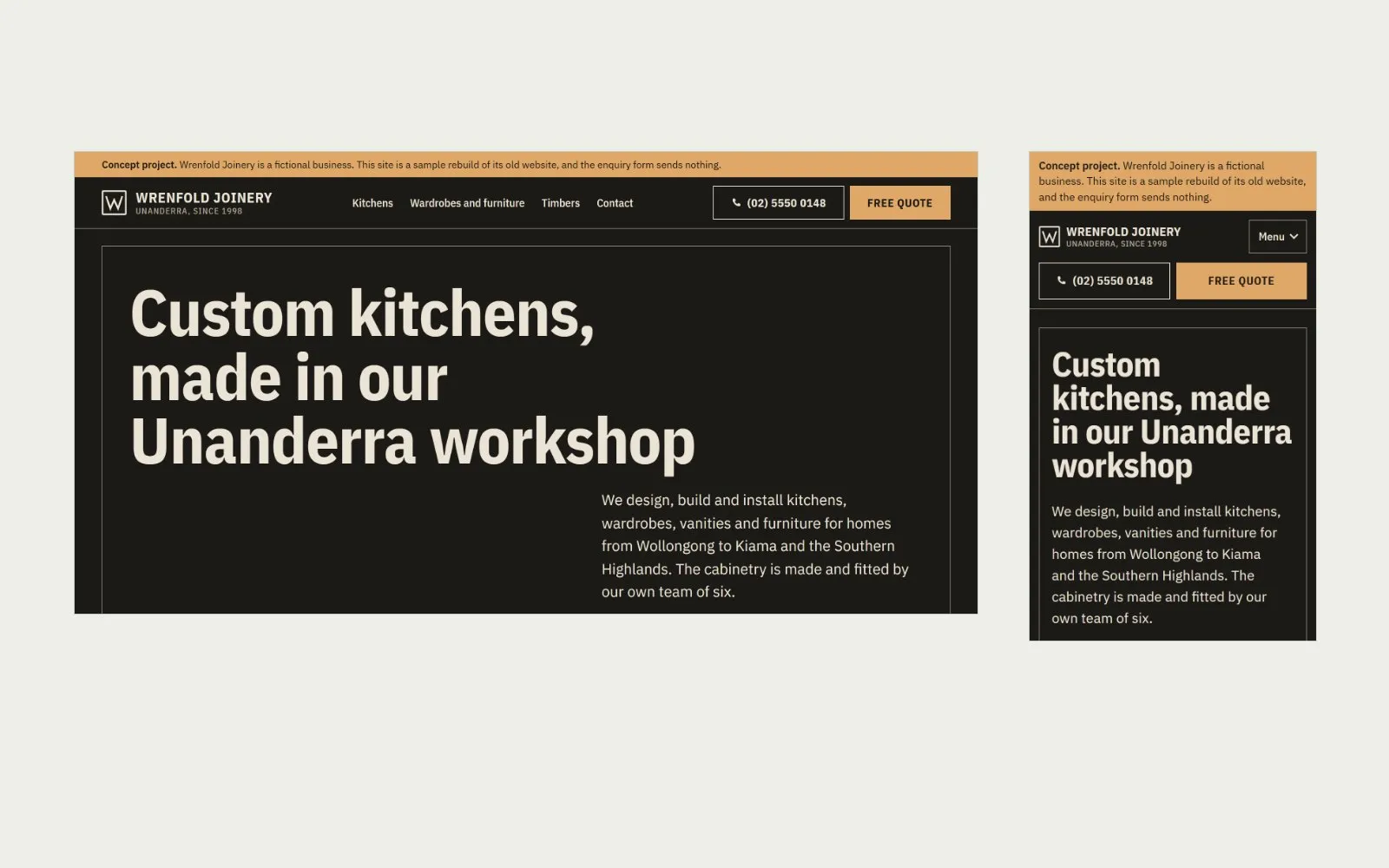
Wrenfold Joinery is not a real business. It is the family kitchen workshop in Unanderra whose deliberately dated website we audited in our sample audit. This concept is the rebuild that audit pointed to, written up as an agency would brief it: more booked measure-and-quotes from homeowners who look for a joiner on their phones, with a call button and a free-quote button on the first screen of every page.
The audit found 15 problems. The enquiry form posted to a script that no longer existed, so every enquiry was lost. The Kitchens page told Google not to list it. On a phone the site was a shrunken desktop page whose slideshow took most of a minute to appear. The rebuild addresses all 15, keeps the old page addresses so links Google already has still work, and shows the contractor licence the trade needs to display. Its enquiry form is built and checked but, as a concept, sends nothing; on a client’s site it goes to the agency’s form handler.
The design is a set of drawing sheets, because every Wrenfold job starts as a measured drawing the customer signs off. Each page opens on a framed sheet with a ruled title block along its foot. On the home page it gives the lead time and the free measure and quote. Below it are the documents a joiner works from: the kitchen programme as a dimension string, what the workshop makes as a cutting list, and the timbers as a materials schedule with drawn colour chips. The chips are labelled as drawn, because we won’t show someone else’s kitchen or timber as this workshop’s work.
Measured before and after
Both sites were served locally, the rebuild with the host settings it specifies, and run through the same audit script on 11 November 2026. Lighthouse 13.6.0 ran three times per page; the median run is shown. The phone test is Lighthouse’s simulated slow phone on a throttled mobile connection, so real visitors’ times will differ, and results vary a little from run to run. The copy linked from this page is marked noindex and sits on our server, so a Lighthouse run on it scores lower for SEO than the client’s own site would.
| Measure | Before | After |
|---|---|---|
| Home page: main content shown, phone test | 45.5 s | 0.8 s |
| Timbers (gallery) page: main content shown, phone test | 62.0 s | 0.8 s |
| Home page weight | 8.7 MB | 100 kB |
| Timbers (gallery) page weight | 15.8 MB | 98 kB |
| Home page Lighthouse scores, phone test (performance / accessibility / best practices / SEO) | 74 / 67 / 96 / 73 | All 100 |
| Page elements failing axe’s accessibility rules | 161 | 0 |
| Text too faint to meet the contrast minimum | 106 | 0 |
| Links to missing pages and files | 3 | 0 |
| Enquiry form sending to a script that no longer exists | 1 | 0 |
| Tap-to-call links | 0 | 19 |
| Pages hidden from search with noindex | 1 | 0 |
| Standard security headers missing | 6 of 6 | 0 |
Every page of the rebuild scores 100 in all 4 Lighthouse categories on the phone test, with its main content shown in under 2 s and no layout shift.
How it was made
The site is plain HTML and CSS with two small scripts (the phone menu and the form), two self-hosted fonts and no tracking, so any developer can maintain it. It was checked against our written standard at every stage: automated tests on every page (html-validate, axe and the audit tools above), an AI design review of screenshots at the four standard widths from 375 to 1920 px, plus 320 px, in three browsers, and a separate AI review given the work, the brief and the checklist but never the building model’s own verdict. Its findings were fixed and checked again.